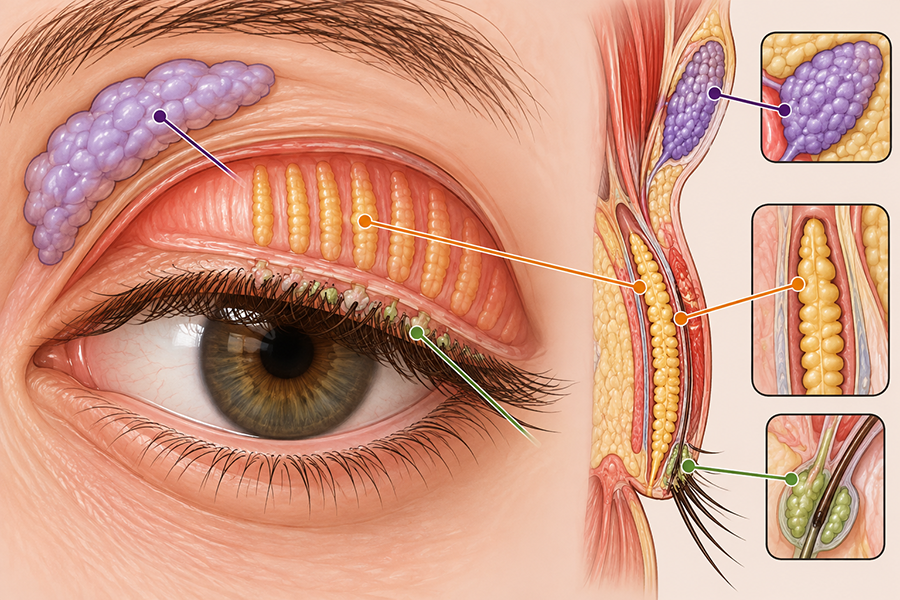
One day, a lump appears on the eyelid – sometimes red and painful, sometimes causing…

Conjunctivitis in autumn
With the first few weeks of school and nursery come the first signs of infection: colds, coughs and, very often, conjunctivitis. This is an inflammation of the conjunctiva, the thin membrane that lines the white of the eye and the inside of the eyelids. It is usually mild, but some forms are highly contagious and it is important to be able to recognise them.
Three types, three presentations
- Viral. This is the most common form, often occurring alongside a cold. Symptoms include a red eye, watery eyes, a gritty sensation and a watery discharge. It usually starts in one eye and spreads to the other within a few days. It is highly contagious and can last for one or two weeks.
- More common in children. Thick, yellowish or greenish discharge, and eyelids stuck together upon waking. It is also contagious.
- Allergic. Intense itching in both eyes at the same time, often accompanied by sneezing or a runny nose. It is not contagious.
Only a doctor can confirm which type it is and whether treatment is needed.
How to prevent the spread of infection at home
- Wash your hands frequently, especially after touching your eyes or applying eye drops.
- Use your own towel, pillow and tissues. Disposable tissues are best.
- Wipe away any discharge with sterile gauze and saline solution, using a separate piece of gauze for each eye, wiping from the inner corner outwards.
- Do not share eye drops or make-up, and throw away any eye make-up used during the infection.
- If you wear contact lenses, remove them until your doctor tells you otherwise and replace the lens case.
- Avoid home remedies such as chamomile or tap water.
Returning to school depends on the type of conjunctivitis, your paediatrician’s advice and the rules at each school.
When to seek immediate medical advice
Most cases of conjunctivitis are not serious, but you should consult your doctor as soon as possible if there is severe pain, significant sensitivity to light, or blurred vision that does not improve when blinking; if the affected person is a baby under one month old; if you wear contact lenses; or if the eye has been struck or has a foreign body in it. If the symptoms are severe and you cannot contact your doctor, go to the A&E department at your nearest hospital.
You should also avoid using leftover eye drops from a previous treatment, particularly those containing corticosteroids: in some infections, these can make the condition worse.
If the conjunctivitis recurs or does not improve within the expected timeframe, we can assess you at INOF or the Teknon Medical Centre.
Temas relacionados