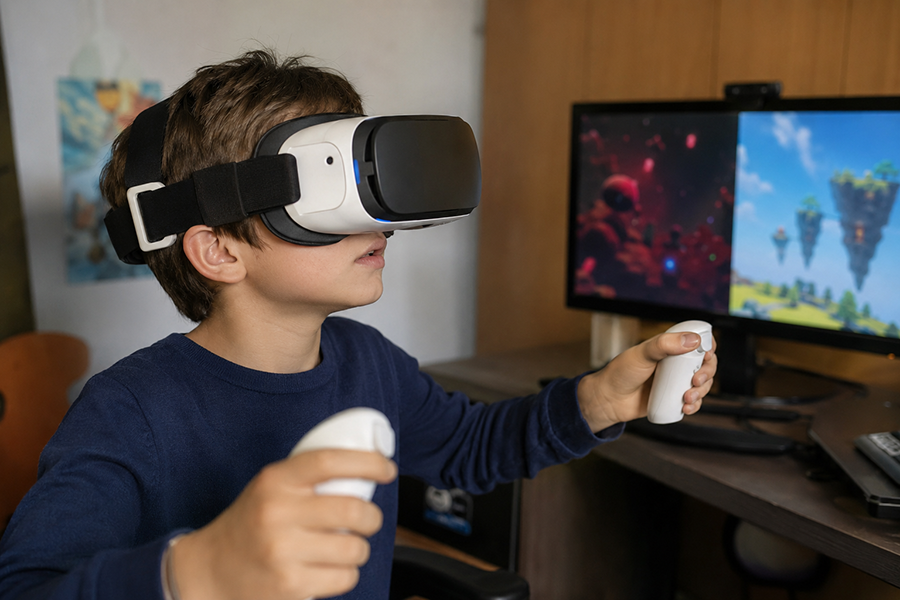
For decades, the go-to treatment for lazy eye (amblyopia) has been to cover the healthy…
Lazy Eye: Why Time Matters So Much
Amblyopia, commonly known as a ‘lazy eye’, is the loss of vision in one eye which, whilst structurally normal, has failed to develop its full visual capacity. It is not a problem with the eye itself, but rather with the connection between that eye and the brain, which did not receive adequate stimulation during the early years of life.
It is the most common cause of vision loss in childhood, and also one of the most subtle.
Why it goes unnoticed
A child with a lazy eye can see perfectly well with the other eye. They do not complain, do not trip over things, and show no obvious difficulties in their day-to-day life. They might accidentally cover their good eye whilst colouring and notice something strange, but they have no way of knowing that this is not normal, nor the words to explain it.
That is why many cases are discovered by chance, during a routine check-up or when the child covers one eye for any reason. And that is why early detection depends on someone carrying out the test, not on the appearance of a symptom.
Why it occurs
Three causes account for the majority of cases:
- When one eye turns inwards, the brain suppresses its image to prevent double vision, and that eye stops developing.
- A difference in prescription between the two eyes. This is the most insidious cause, as there are no outward signs. If one eye has a significantly higher prescription than the other, the brain relies on the eye that sees clearly and neglects the other.
An obstruction in the visual axis. A congenital cataract or a drooping eyelid covering the pupil prevents a clear image from reaching the eye during the critical period of development.
How long can it be treated?
The sooner, the better. The visual system is particularly malleable during the early years, and treatment started early yields better results in a shorter time.
That said, it is worth clarifying a deeply held belief. For decades, it was claimed that once a child had passed the age of seven or eight, there was nothing that could be done. Evidence accumulated in recent years has shown that a proportion of patients older than this age, and even teenagers, show improvement with appropriate treatment. Not always, not in every case, and not to the point of full recovery, but enough to make it worth assessing rather than writing them off in advance.
What the treatment involves
The first step is always to correct whatever is preventing a clear image from reaching the eye: the prescription with the appropriate optical correction, or the obstruction, if there is one. This step alone improves a significant number of cases.
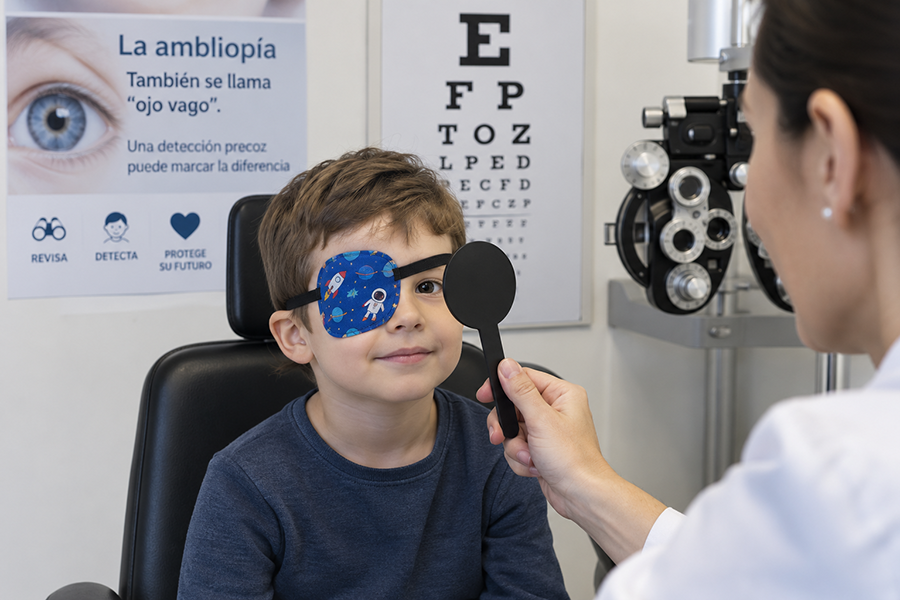
From there, depending on the individual case, efforts are made to encourage the brain to use the amblyopic eye. Occlusion of the dominant eye using an eye patch remains the standard treatment, with the duration of occlusion tailored to the child’s age and the severity of the amblyopia; pharmacological suppression is also available as an alternative in selected cases, as are visual therapy programmes that also work on the integration of both eyes.
Follow-up is just as important as the treatment itself: it is essential to check that the treated eye is improving and that the dominant eye is not being adversely affected.
The practical advice
Do not wait for the child to complain, because they will not. An eye examination at around three or four years of age can detect amblyopia whilst it is still easily treatable. If there is a family history of lazy eye, strabismus or high prescriptions, it is advisable to bring the examination forward.
Temas relacionados