Water takes centre stage in summer, and is also the cause of much of the…
Nystagmus: when the eyes won’t stop moving
Nystagmus is an involuntary, rhythmic and repetitive movement of the eyes, which may be horizontal, vertical or rotational. The person cannot control it and, depending on the case, it may reduce visual acuity.
Two very different forms
Infantile nystagmus. This appears in the first few months of life. It is sometimes associated with other visual problems (affecting the retina, the optic nerve or visual development), whilst in other cases no cause can be found. Children with infantile nystagmus do not usually perceive that their surroundings are moving, as their brain has adapted to it since birth.
Acquired nystagmus. This develops later in life, in adulthood or in a child who did not previously have it. It may be due to neurological causes, problems with the inner ear or certain medicines. The person often notices that images ‘dance’ or move (oscillopsia).
Go to A&E or call 112 if the eye movement starts suddenly, particularly if it is accompanied by severe dizziness, double vision, a headache, difficulty speaking or walking, or weakness.
The fixation position
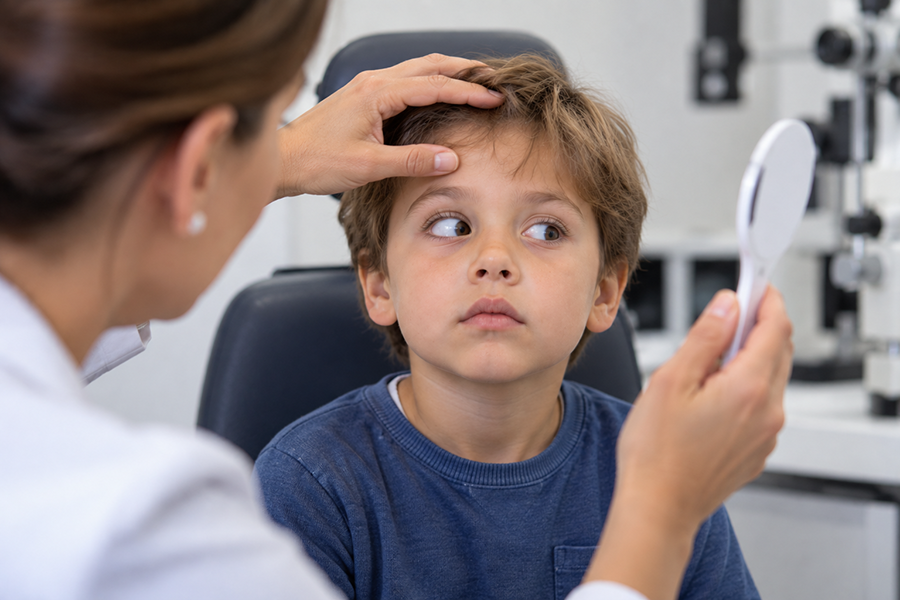
Many people with nystagmus have a particular direction of gaze in which the movement diminishes and they can see more clearly. To make the most of this, they habitually turn or tilt their head. If a child always tilts their head to look at things, it is advisable to rule out an eye-related cause.
Treatment
Paediatric nystagmus does not usually disappear, but there are many things that can be done to improve vision: accurately correcting the prescription, using prisms in spectacles or, in selected cases, undergoing eye muscle surgery to improve head posture. In acquired nystagmus, the first step is to identify and treat the cause. During school years, simple measures can help, such as sitting close to the blackboard or using materials with larger print.
At INOF
Nystagmus is one of the areas of specialisation within INOF’s Binocular Vision, Strabismus and Neuro-ophthalmology Unit, headed by Dr Dora Fernández-Agrafojo.
Would you like an assessment? You can book an appointment on 640 310 733 or at atencionalpaciente@inof.es. INOF clinic at the Teknon Medical Centre, C/ Vilana 12, consultation rooms 156–159, 08022 Barcelona.
*Dr Dora Fernández-Agrafojo · INOF, Binocular Vision, Strabismus and Neuro-ophthalmology Unit*
Temas relacionados