When a child has a squint, parents receive a lot of well-meaning advice. Some of…

When an eye goes out “only sometimes”: intermittent exotropy
“It only happens sometimes.” This is a phrase frequently heard in strabismus consultations. Parents notice that one of their child’s eyes occasionally turns outward: at the end of the day, when they are distracted, when watching television from a distance, or in certain photographs. The rest of the time, the eyes appear perfectly straight, making it easy to assume that it is nothing to worry about.
In many cases, this is intermittent exotropia, one of the most common types of strabismus in childhood. It can also occur or become noticeable in adults.
How to Recognise It
- One eye occasionally turns outward, particularly when looking into the distance.
- It becomes more noticeable when the child is tired, sleepy, unwell, or daydreaming.
- In bright sunlight, the child closes one eye. This is a very characteristic sign and often the first thing families notice.
- In adults, it may cause eye strain, difficulty concentrating while reading, or occasional double vision.
Why It Should Not Be Ignored
When the eyes are straight, the brain makes an effort to keep them aligned. This is known as control. In some cases, control remains stable for years, but in others it gradually deteriorates: the eye turns outward more and more frequently, and the deviation may eventually become constant.
What is at stake is binocular vision, the ability to use both eyes together and perceive depth. A child may have good vision in each eye individually and yet fail to use both eyes together when one eye turns outward. This is why it is important to assess how the condition progresses over time, rather than simply measuring the degree of deviation at a particular moment.
How Is It Diagnosed?
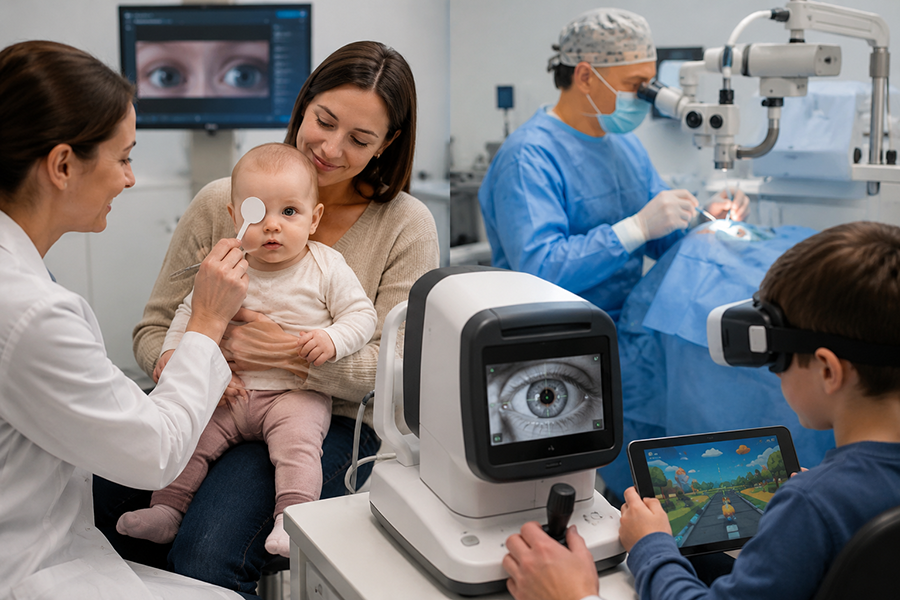
A comprehensive eye examination is required, including visual acuity testing for each eye, a refraction assessment using eye drops to relax the focusing muscles, measurement of the deviation at both distance and near, evaluation of the degree of control, and assessment of binocular vision.
Video-oculography also makes it possible to objectively record eye movements, which is particularly useful for comparing results between follow-up appointments.
Because the condition can vary from one day to the next, regular monitoring is an essential part of the diagnostic process.
How Is It Treated?
Not all cases of intermittent exotropia require surgery. Depending on the individual case, the specialist may recommend:
- Monitoring: Regular follow-up appointments when control is good and stable.
- Glasses: If there is a refractive error that needs correcting.
- Patching or eye exercises: In selected cases, to help improve control.
- Surgery: When control deteriorates, the deviation becomes frequent or constant, or symptoms develop.
The aim is to keep the eyes aligned and, above all, to preserve binocular vision.
At INOF
Dr Dora Fernández-Agrafojo, Director of INOF, specialises in strabismus in both children and adults. Her doctoral thesis, awarded cum laude, focused specifically on the surgical treatment of divergent strabismus, the category to which intermittent exotropia belongs.
If you notice that your child’s eye, or your own, occasionally turns outward, even if it only happens from time to time, seek specialist advice.
Book an Appointment at INOF · Teknon Medical Centre, Consulting Rooms 156–159 · Tel. +34 933 933 156 · WhatsApp +34 640 310 733 · atencionalpaciente@inof.es
Temas relacionados