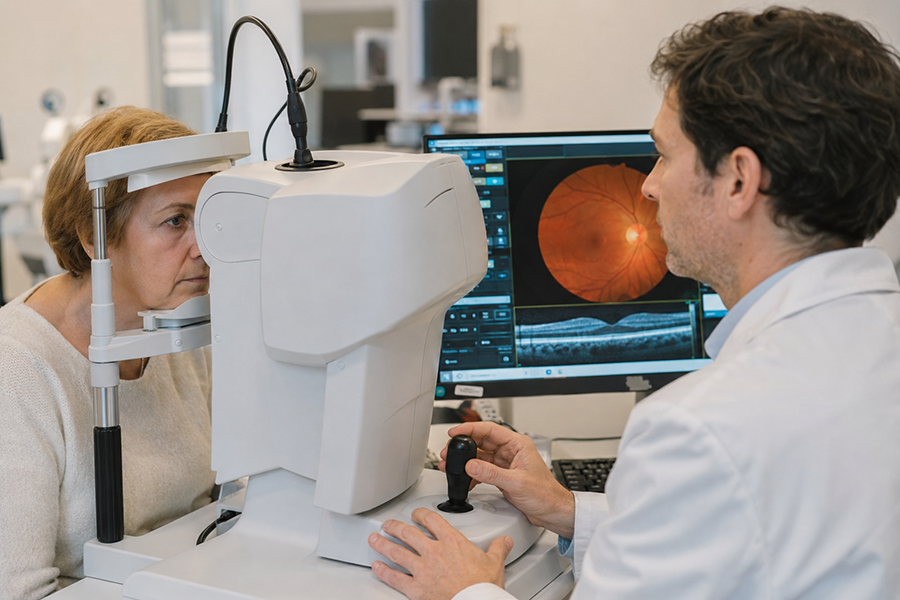
September is the month when the most paediatric ophthalmology appointments are booked, and this is…
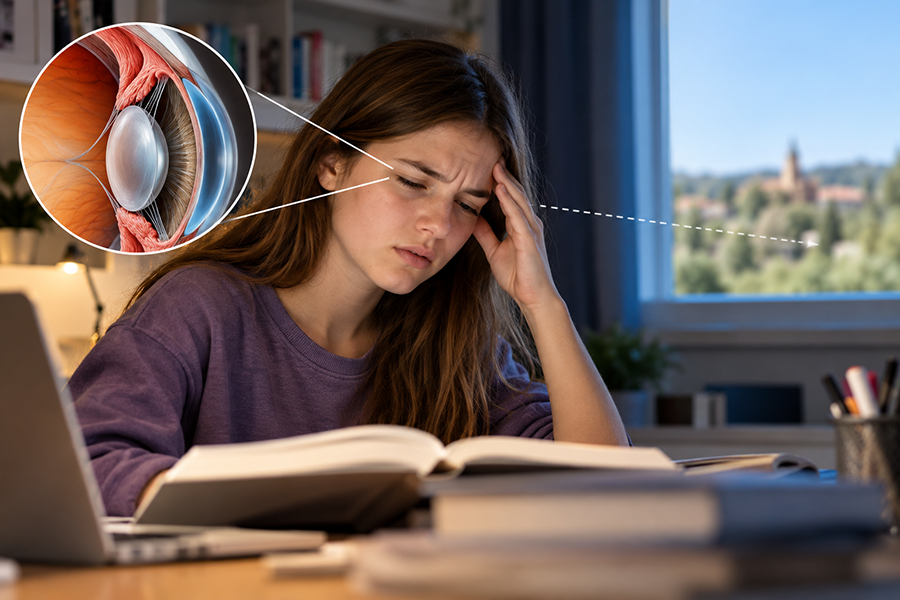
Accommodative spasm: when the eye remains focused on close objects
To see things up close, the eye focuses thanks to a small internal muscle, the ciliary muscle. This is what we call accommodation. When we spend many hours on end reading, studying or looking at screens, that muscle can remain contracted even when it is no longer needed, much like a cramp. This is known as an accommodative spasm, or accommodation spasm.
Symptoms
- Blurred distance vision, particularly when looking up from a book or screen.
- Headache, often at the end of the day.
- Eye strain and discomfort when reading.
- Vision that comes and goes: sometimes you can see clearly, and sometimes you cannot.
- In some cases, eyes that tend to cross or double vision when looking at close objects.
It is more common in older children, teenagers and young adults who place heavy demands on their near vision, and often coincides with periods of intense study or stress.
Why it is important to diagnose it correctly
As the person’s distant vision is blurred, accommodative spasm can be mistaken for short-sightedness (which is why it is also called pseudomyopia). If the prescription is measured without relaxing the focus, there is a risk of prescribing glasses for short-sightedness that are unnecessary and may worsen the discomfort.
To diagnose it, the ophthalmologist measures the prescription using eye drops that temporarily relax the ciliary muscle. If the short-sightedness disappears or is significantly reduced with the drops, the problem lies with focusing, not the prescription.
Treatment
This depends on each individual case. It usually involves a combination of breaks and good eye care habits, the correction of any other refractive errors (such as hyperopia), and occasionally eye drops prescribed for a period of time or visual therapy to restore flexible focusing.
A simple habit to help prevent it: for every 20 minutes of close-up work, look at something in the distance – about 6 metres away – for around 20 seconds.
At INOF
Accommodative spasm forms part of the binocular vision assessment carried out by Dr Dora Fernández-Agrafojo’s unit. She is the author, alongside other INOF professionals, of the article ‘Treatment of accommodative spasm’, published in the journal Annals d’Oftalmologia (vol. 33, no. 1, 2025).
Would you like an assessment? You can book an appointment by calling 640 310 733 or emailing atencionalpaciente@inof.es. INOF clinic at the Teknon Medical Centre, C/ Vilana 12, consultation rooms 156–159, 08022 Barcelona.
*Dr Dora Fernández-Agrafojo · INOF, Binocular Vision, Strabismus and Neuro-ophthalmology Unit*
Temas relacionados